WW2 Brain Bucket
How did Hitler Fool Stalin so Badly with the Invasion of the USSR? | WW2 Brain Bucket Reader Q&A
Today we look at how Hitler duped Stalin by invading the Soviet Union, Hirohito’s Allied post-war makeover, Axis POWs in the US, UK & more!

In the Second World War, there is nothing as perplexing as to how Adolf Hitler fooled Joseph Stalin so completely in launching Operation Barbarossa – the German invasion of the Soviet Union. Nor are there many debates that are still so relevant to the politics of a nation than Emperor Hirohito’s role directing the war for Japan. It is also a tragedy for posterity that most people don’t know the names of either General George C. Marshall or Field Marshal Lord Alanbrooke. Even fewer know the incredible story of how German and Italian POWs were kept by the Allies, especially the camps in the United States. However there is a more pressing introduction before getting down to your questions.
Over the last several years during my myriad published pieces on the Second World War, as well as critiquing its role in Amazon Prime’s adaptation of The Man in the High Castle, I have received many emails from readers asking questions about the subject as a whole. Its amazing hearing from people who have a strong curiosity about the wars history, and want the best information possible. After I was encouraged by those reaching out to me to start a reader submitted question and answer column, providing informed answers to any questions relating to WW2, I have chosen to take up the gauntlet.
First things first, what the hell is a brain bucket? A brain bucket is a military colloquialism for a combat helmet. When searching for answers and historical understanding, the process is often volatile and incendiary. So, it’s always good to wear that brain bucket.
Here are the Brain Bucket Q&A ground rules:
- I will choose several questions a month. If your e-mail isn’t picked, don’t be discouraged. I can only answer so many at a time. Feel free to resubmit the question for the following month.
- Any question about or related to the Second World War is fair game. Even if you think its a little strange and off the beaten path, send it in. More often than not, history is both of those things and more. That also includes its place or role in popular culture, current or ongoing controversies related to the subject, and pretty much anything else you can fathom.
- My replies to your questions will be thorough. If you have taken the time to e-mail a question I have chosen, you deserve the best possible answer.
- Most importantly as an unequivocal rule, I am only interested in evaluating history within the context of the era it occurred. Imposing contemporary values and societal norms on history accomplishes less than nothing. One can learn from history by taking those lessons to help best guide to a better future. However viewing history within the scope of a modern worldview is an exercise in futility. It has been aptly stated that the past is like another country, and much like learning about another culture it can only be evaluated in the context of its people, their customs, and unique history. In the end the only real goal is understanding, whether or not it comports to the beliefs and disposition of the present.
- My answer to your question is only the tip of the iceberg. I will include recommended reading and viewing so you can research the specific issue further.
Do you have a question about WW2? E-mail the Brain Bucket!
Now, down to business and your questions!
Q: I am just getting into the history of the Eastern Front. The more I learn, the more I can’t understand how Stalin was actually so caught off guard by the Nazi invasion of Russia. It seemed pretty obvious even at the time. How did Germany dupe Stalin so completely?
– Kyle, Macon, GA
This really goes under the category of Stalin being too close to the forest to see the trees. While contemporary Soviet propaganda would have you picture the despot ruling benevolently and omnisciently from his Kremlin perch, Stalin was just as limited as his fellow dictators at the time. In short, he was still human and fully capable of misinterpreting even the best of intelligence about Nazi duplicity, as we shall see.
The Nazi-Soviet Pact: A “Non-Aggression Pact” that was really a Pact of Mutual Assistance Between Hitler and Stalin


The so-called Molotov-Ribbentrop Pact whose division of Eastern Europe, the Balkans and Baltic states still dictates national borders in those regions today
So it is important to recall that prior to 22 June 1941, the Soviet Union and Nazi Germany were bound together in the Molotov-Ribbentrop pact (named after each country’s respective foreign ministers). Publicly each side was very careful to refer to the new political relationship as only a pact of non-aggression. However their two year affiliation went much further despite neither side forgetting the near decade worth of mud each had slung at the other. They both were, after all, ideologically opposing powers.
To begin, the two antithetical nations fired the war’s opening salvo practically hand-in-hand. The Soviets discreetly contributed operational support for Germany during the Poland invasion by transmitting Luftwaffe navigational signals from Minsk. Additionally Stalin personally obliged a German request for use of a small U-Boat base outside Murmansk, Basis Nord, prior to the invasion of Norway in April 1940.
Nazi Germany and the Soviet Union further negotiated two large commercial trade agreements for the duration of the pact; with the Soviet Union trading raw materials, agricultural products, and oil in growing amounts aiding Germany to compensate for the British blockade at sea. The Soviets in exchange finagled acquiring highly coveted German industrial manufacturing goods, and civil/military technologies. The Soviets even managed to acquire the blueprints to the famed Bismarck-class battleship; as well as the incomplete Admiral Hipper class heavy cruiser Lützow – promptly renamed the Petropovlovsk upon its arrival at Leningrad in April 1940.
The pact further carved out explicitly agreed upon “spheres of influence” between the two powers in Eastern Europe and the Balkans. Specifically, the prostrate Poland would be partitioned between the two powers; while the Baltic states would be ceded to Moscow. Likewise, the region of Bessarabia – modern day Moldova – would be annexed from eastern Romania and transferred to the Soviet Union. In addition to the Soviets acquiring the more contentious Romanian province of Northern Bukovina, which was not included in the aforementioned pact.
Nazi Germany in exchange for these territories secured their eastern flank from Soviet intervention, allowing them to seize half of Poland and later concentrate on their wars in the West. Without a doubt, both Germany and the Soviet Union gained firm, tangible yields from their collaboration.
For Stalin in August 1939, the biggest potential benefit from the pact was possibly bogging down Germany in their war with the West. Stalin believed that with a German invasion of the West, a major war of attrition between the waring powers would ensue.
Stalin hoped that such a quagmire would be similar to the fighting on the Western Front during the First World War, keeping his German partner wholly engaged against Britain and France. If that become so Stalin figured, the Soviet Union would be given a free hand to do as it pleased elsewhere with little interference. Perhaps even with the Soviet Union playing agent provocateur to keep both sides in a vicious fight indefinitely.
Stalin was also buying time to ready the then chaotic state of the Red Army, before the growing conflict engulfed the Soviet Union.
After decapitating his officer corps with politically motivated purges in the late 1930’s, while reorganizing the Red Army to adopt new doctrinal priorities, and implementing an array of new weapons technology – the Red Army was pretty much a mess between 1939 – 1941.
This reality strongly bore out in their humiliating, yet ultimately successful pyrrhic victory in the Winter War with Finland to seize the Karelian Isthmus, and the Finnish second city of Viipuri – now Russian Vyborg.
As events unfolded in continental Europe, Stalin became quickly disabused. Hitler would complete his conquest of Norway, Denmark, the Low Countries and France by the end of June 1940.
Ideology vs. Grand Strategy: Stalin, Bolshevism & the Manic Mind of the Führer
Nazi Germany and the Soviet Union generated palpable benefits from their pact, it is true; however ideology won out in Hitler’s mind. National Socialism’s main philosophical tenets were partly based on a violent rejection of Soviet communism. The Nazi movement has, in fact, it’s genesis as a reaction to the various far left movements in Germany following its defeat in the First World War.
Soviet communism, even worse in Hitler’s mind, was at its constitution composed of the groups Nazism was infamously targeting most – the Jews and Slavs. It did not help that many major Bolshevik figures involved in the 1917 October coup were both. To this day, Nazism’s views roughly comport to what was known as “The Judeo-Bolshevik Conspiracy.”
To explain this ridiculous ideological patchwork, it can be best understood as follows:
The conspiracy boils down to the idea that Judaism, by virtue of a massive international conspiracy, seeks to dominate and enslave humanity through Communism. Moreover Soviet communism, specifically Moscow itself, was viewed as the epicenter of this conspiracy. This is due to prominent cohorts of the Bolshevik party leader Vladimir Lenin being of Jewish descent. Though Hitler’s designs on the Soviet Union expand beyond the mere ideological.
Accompanying the fact the USSR and Nazi Germany were natural economic partners, Hitler much preferred conquering those Soviet assets rather than trading for them. In Mein Kamp Hitler spoke of German “Leibensraum” – living space – for colonization in what was the western Soviet Union. Ultimately seeking to forcibly seize the very raw materials Germany was trading for, and enslaving the Slavic population.
This idea was not unique to Nazism in Germany. Leibensraum roughly comports to the 19th century German nationalistic concept of “Drang nach Osten” or “Drive to the East,” that promoted a unified Germany conquer the traditional Slavic lands.
What is quite interesting is that if you look at the entirety of the European war, almost everything Nazi Germany did was clearly outlined in Hitler’s so-called autobiography; dictating each word to fellow Nazi and inmate Rudolf Hess serving time in Landsberg Prison, Mein Kampf.
Did Stalin even read Mein Kampf?
Apparently so. Stalin was a voracious reader, accumulating a vast personal library. Stalin’s library included many books one might not expect to see on the shelf of Marxist-Leninist number one – like say, the Bible. Stalin possessed a translated copy of Mein Kampf, marking it up extensively. He knew exactly the ideology that Nazism embodied, as well as the target sitting on his back.
Yet in the first half of 1941, the Vhoz had reason to believe himself outside the Nazis’ crosshairs.
The Soviet Pre-Barbarossa Intelligence Debacle: Telling Stalin Things He Didn’t Want to Hear
Historian Stephen Kotkin explains in his newest release, Stalin Volume II: Waiting for Hitler 1929-1941 that Soviet intelligence sources were unknowingly blinded to Hitler’s true intentions through disinformation campaigns skillfully run by German counterintelligence in early 1941.
Before their invasion of the Soviet Union, the Nazi regime conveyed many different but seemingly equally plausible reasons for the Wehrmacht’s growing presence in Eastern Europe. In one such explanation, the Germans asserted that their presence, at what was essentially Stalin’s doorstep, was only a temporary stop en route to operations against the British Empire in the Middle East.
Hitler even actively participated in the deception, communicating directly to Stalin that his troops in Poland and East Prussia were nothing to worry about; that they were only there to be out of range of RAF bombers hitting Germany.
Moreover, Germany was actively feeding disinformation to their own diplomats in Moscow. Incredibly, the German foreign ministry officials tasked with managing Soviet-German relations on the ground did not know the information provided by their own government was in fact disinformation. Nazi Germany’s own diplomatic presence was not in on the Operation Barbarossa secret.
These mis/disinformation operations could only succeed so long as they fit Stalin’s preconceptions of Hitler’s military goals. Unfortunately for the Soviet Union, they fit a little too well. The paranoid dictator may not have accepted the stated reasons for Germany’s presence, but he did believe that Hitler was trying to exert pressure on the Soviet Union by his military buildup on their frontier, hoping to coerce various concessions from the Kremlin to Germany’s benefit. Speculation to this end varied from hoping to extract greater material benefit via trade, to the Soviet Union leasing Ukraine to Germany for 99 years following a German ultimatum.
The NKVD & GRU Alert at the Wheel
Throughout this ordeal, the Soviet Union’s main intelligence arms the GRU (military intelligence), and the separate NKVD, were not asleep at the wheel. The NKVD specifically created a bulging intelligence dossier codenamed “Zateya” or “Venture” to examine Hitler’s true intentions. Though as far reaching as GRU and NKVD assets were, they did not impress Stalin. For example, in early 1941 there were countless reports from Soviet agents portending the German date of invasion – that would invariably pass without incident.
These instances only reinforced Stalin’s own diposistion and views. Moreover, any Soviet apparatchik was careful to report intelligence the Soviet despot didn’t want to hear, or didn’t conform to his interpretation of events. Many had been purged and executed for less. Naturally this created a perilous situation for the Soviet nation.
Still, some Soviet intelligence assets did try to raise the alarm with accurate reports about impending Nazi betrayal. The most historically prominent was Richard Sorge, a German journalist posted to the German embassy in Tokyo working in service to the GRU. Sorge’s position at the embassy enabled him to provide the exact date for the invasion to his superiors. Yet Sorge was one voice among many, however, and no leader has ever lost an empire by taking all their spies reports at face value.


In the history of espionage, most spies are seldom honored with their own stamp. Kim Philby enjoyed this honor as well in the Soviet Union.
Furthermore, Stalin slavishly believed that Hitler would never attack the Soviet Union while still being at war with the British. In Mein Kampf Hitler was unequivocal about his belief that Germany lost the First World War because it was engaged in war on two fronts. Stalin hitched a great deal to this oft stated opinion by the Führer. Stalin’s conviction neglected one obvious fact: Germany may still have been at war with the British Empire, however, the British Army did not have a single fighting soldier in continental Europe at the time. Yes, there was the fighting happening in colonial North Africa and British strategic bombing, but this hardly constituted a second front great enough in Hitler’s eyes to deter his Soviet ambitions.
Stalin’s Misperception: Who Was Really Calling the Shots in the Third Reich at War?
Last, but hardly least, Stalin had a major misperception of how power was exercised within the structure of the Third Reich at war. Stalin, by using the First World War as precedent, assumed that German military leadership once again had the real decision making powers for use of force during war; thus paralleling Kaiser Wilhelm II ceding effective control of Germany to the duumvirate of Paul von Hiddenburg and Erich Ludendorff.
Stalin supposed that the Wehrmacht generals – not Hitler himself – wanted war with the Soviet Union. In truth more the opposite was true, even though no one in Wehrmacht leadership spoke out in opposition to Barbarossa at the time – despite post-war claims. Based on this erroneous assumption, Stalin issued strict orders to avoid doing anything that could be perceived as a Soviet provocation, creating a German Casus belli. Especially at their common western border in occupied Poland.
With the benefit of hindsight and access to archival records from both sides, Hitler’s intentions appear incredibly obvious now; while for some the Führer’s schemes may have seemed just as clear at the time. Yet when using prospective history, as opposed to retrospective history, one can see how this calamity came to pass.
When considering the highly effective disinformation campaigns German intelligence was employing, a Soviet intelligence apparatus unwilling to tell their mercurial boss something he didn’t want to hear, enmeshing it with Stalin’s devotion to his own personal interpretation of events and ironclad worldview, disaster ultimately ensued. In short, the only opinion that mattered was Stalin’s; with the Vhoz drastically miscalculating the strategic equation and misreading the Nazi dictator.
Now you know the rest of the story, as it were.
Recommended Reading:
- “The Devil’s Alliance: Hitler’s Pact with Stalin, 1939 – 1941” by Roger Moorhouse
- “Stalin, Volume II: Waiting for Hitler, 1929-1941” by Stephen Kotkin
- “What Stalin Knew: The Enigma of Barbarossa” by David E. Murphy
- “Grand Delusion: Stalin and the German Invasion of Russia” by Gabriel Gorodetsky
Recommended Watching:
- “World War II Behind Closed Doors: Stalin, The Nazi’s and the West” directed by Laurence Rees
- “World War Two: 1941 and the Man of Steel” hosted by David Reynolds
- “Warlords” (2007) directed by Simon Berthon
Article Continues on the Next Page…
Q: When Japan surrendered to the Allies, how was it possible that the Emporer [Hirohito] was allowed to stay Emporer? Wasn’t he a war criminal? If Hitler or Mussolini were captured alive they would have been executed.
– Sean, Portsmouth UK
To borrow Dave Chappelle’s warning before leading into combustible social topics, answering this question enters “deep waters.”
The Allies, specifically the United States, had several major goals in rebuilding post-war Japan:
- Transforming Japan into a representative, liberal western style democracy.
- Helping Japan build the foundation of a prosperous East Asian economy.
- Ensuring Japan was incapable of posing a military threat to the U.S. or it’s Asian neighbors by creating a new national constitution, formally renouncing war as a means for its foreign policy.
- Making Japan a stalwart anti-Communist ally to the West, with the quickly ensuing Cold War clearly in view.
That all seems pretty straightforward, right?
There are any number of ways the Allies might have achieved these objectives, yet none of them would be easy. Japan, like most of the world, was shattered following their surrender and eight years of war. Consequently, the Allies needed all the help they could recruit to achieve a national rebirth along the aforementioned lines. Despite how it may sound at first, the one person who might prove most useful was also public enemy number one in the US following Pearl Harbor, Emperor Hirohito.
Following Imperial Japan’s official surrender on September 2nd, 1945, the Allies quickly realized their occupation faced a very sticky situation in the form of the defeated monarch. Foremost, Hirohito was the single surviving Axis head of state available for prosecution as a war criminal. Complicating matters was the fact the Emperor was worshiped as a living god by the Japanese people. Reconciling these two extremes judicially in a way that satisfied the Allied powers, while simultaneously using the symbolic power of the Emperor for rebuilding Japan was a daunting task.
So, how could the Allies even suggest that Hirohito retain his throne? The answers boils down to the stark differences of personality and style of rule between the Japanese Emperor and the two other major Axis warlords.
Who was Hirohito the Man? Who was Hirohito the Emperor?
The best way to answer this question is stating what Hirohito was not. To begin, Hirohito’s personality did not posses the bellicosity demonstrated by Hitler or Mussolini. One would never see Hirohito wild-eyed in a state of self-important zeal atop a makeshift pulpit, rallying a crowd to his cause. Japanese Emperors simply did not behave in such a fashion.
Emporers did not “go out” among their subjects to foment unrest because, in contrast to the other Axis leaders, Emperor Hirohito did not come from the subject Japanese people at all. Hirohito was raised, educated and lived in the isolation of the imperial court. Japanese emperors lived apart and above their empire.
A salient demonstration of Hirohito’s total isolation from his subjects was observed during his first ever direct public address, the so-called “Jewel Voice Broadcast,” explaining to his people Japan’s capitulation to the Allies. Hirohito was delivering the speech in a highly formal and largely archaic form of Japanese to the point that many had trouble understanding him. This was not a leader who experienced contact with commoners.
In person Hirohito was reserved and precise in his manner, with clearly practiced royal etiquette. He personally took great intellectual joy studying the natural sciences. Hirohito might have made for an intriguing, albeit stiff, dinner companion. However a strong armed, populist despot Hirohito was not; despite embodying ultimate authority in the empire.
All told, he filled the role of a ceremonial democratic monarch far better than one of supreme divine mandated authority to which he was born. Hirohito was very refined by both Eastern and Western standards. In fact, General MacArthur himself seemed to take a personal liking to Hirohito, no doubt helping Hirohito’s personal fortunes significantly. MacArthur was Supreme Commander of Allied Powers, referred to by some as “the blue eyed Shogun” – the top authority – during the post-war Allied occupation.
For all the personal contrast between Hirohito and his slain Axis partners, the most crucial difference were political, and how Hirohito exercised his power as Emperor.
Emperor Hirohito: The Inherent Ambiguity of Ruling vs. Reigning
Emperor Hirohito, primarily by virtue of the post-Meiji imperial institution itself, employed a very different style of leadership than those of Japan’s erstwhile totalitarian Axis partners. Japanese Emperors by design presented a blurred distinction between a monarch that was actively reigning or passively ruling. Hirohito must appear as a divine monarch possessing ultimate authority; while also appearing to his subjects above the fray and vulgarity of politics.
This dynamic on a functional basis meant Hirohito very rarely, if ever, delivered explicit edicts on policy matters. Post-Meiji restoration Emperors would appoint a Prime Minister to act as Head of Government in their name. Therefore an Emperor’s influence can best be described as a tacit or passive form of personal imprimatur.
Ministers in the Japanese government would present matters during an audience with Hirohito, where he provided a wink and nod approval regarding the subject a minister presented to him. The arrangement allowed an Emperor to appear detached from politics, whilst maintaining realistic authority, and insulating him from failure or misdeeds. In relative contrast, Hitler and Mussolini were far more involved by exercising their authority directly.
The distinction greater than all others however is that Hirohito was not just any monarch. The Japanese Emporer was worshipped a god incarnate.
A Divine Mandate
As the inhabitant of the Chrysanthemum Throne, Japanese Emperors were believed to be direct decedents from the Shinto Sun Goddess Amaterasu. Talk about divine-right rule, one cannot achieve a greater level of authority than those officially held by a Japanese Emperor in pre-war, Showa Dynasty Japan. It meant that if Hirohito were mishandled by the Allies, he might well become a revanchist martyr. At worst, the execution of a living god might create a visceral Japanese animosity toward the Allies lasting generations.
Conversely, Hirohito also presented as an opportunity. With Hirohito’s active cooperation, he might unite his shattered nation in line with Allied objectives.
These issues specifically made the decision on how to rebuild Japan going forward very complex for the Allies. Raising legitimate questions about what Hirohito knew regarding the conduct of his nation at war, his realistic involvement in policy making, and the onerous prospect of executing a living god.
Hirohito’s Post-War Potential: Serving the Ends of the Allies and a New Japan
There is no question that as an Absolute Monarch, living god or not, Hirohito as Head of State held the ultimate responsibility for the deeds of his nation at war. However, MacArthur and the Truman Administration saw Hirohito’s potential usefulness to the Allied powers in rebuilding a shattered Japan as more important than retribution for his personal culpability.
If nothing else, the Japanese Emperor was looked to by their nation for moral guidance, and nothing could be more helpful in a time of great uncertainty for the recently defeated Japan. Moreover, the Japanese people’s absolute devotion to their Emperor, serving as a symbolic Head of State, was a potential avenue to put the nations rebirth on a strong initial footing.
The symbolism of the Emporer cooperating with the Allies embodied great significance, communicating to his vanquished subjects to no longer resist their former enemy. The famous picture of Hirohito standing next to MacArthur – who stood no less than 7 inches taller than Hirohito – very powerfully communicated that Japan should think of the occupying powers as no less than their equals. It was quite a leap of logic for a nation nourished on themes of ultranationalism and universal Japanese racial superiority. When coupled with the overarching concept that the co-operation of Hirohito helped legitimize Allied post-war occupation, his personal value was clear.


From left to right: American General Douglas MacArthur & Emperor Hirohito
The Complicated Political Realities of the Post-War Occupation of Japan: Emperor Hirohito & the Allies Make for Strange Bedfellows
For all of the aforementioned potential for Hirohito in rebuilding Japan, he would have only been useful insofar as his personal character was in no way impugned by his perceived role during the war. Moral authority must be accompanied by the highest perceived moral track record. Ensuring that moral high ground was never compromised, Hirohito and the entire imperial family received immunity from war crime prosecution at the post-war International Military Tribunal for the Far East, better known as the Tokyo warcrimes tribunals. Had the tribunals pursued legal retribution against Hirohito, as Head of State, he would have been tried as a war criminal on the same level as Hitler, had the former German dictator not committed suicide in the Führerbunker.
Hirohito’s cooperation came at a high price, as many were calling for Hirohito to be tried and executed for war crimes. China was unequivocal in their demands for his execution, as the Chinese endured almost a decade of barbarity at the hands of the Japanese invader – losing over 10 million of their own. Also by providing immunity for the imperial family, Prince Asaka escaped justice for presiding over the Nanjing massacre. Clearly these were odious political choices.
The Absolution of Emperor Hirohito & Immunity for the Imperial Family from Post-War Prosecution: What did Hirohito Really Know about the Conduct of Japan at War?
With very different and conflicting approaches to the occupation being wrangled with at the time, the question of what Hirohito knew personally about Japanese atrocities remains hotly debated today. Was the emperor at times kept at a distance, left deliberately ignorant of various aspects of his nations misdeeds? It would seem to an extent likely that was so, and such things were far from unheard of elsewhere.
In the practical debate over what Hirohito knew and when is in many respects beyond the point. Even the pre-war Meiji Constitution, if interpreted strictly through the lens of rule of law, puts culpability squarely at the feet of the Emperor:
“Article 4. The Emperor is the head of the Empire, combining in himself the rights of sovereignty, and exercises them, according to the provisions of the present Constitution.”
“Article 11. The Emperor has the supreme command of the Army and Navy.”
“Article 13. The Emperor declares war, makes peace, and concludes treaties.”
Even by his nations own legal measure, Hirohito was technically dead to rights regarding his responsibilities as Emperor.
With all of this in mind, one must ask themselves: “If Hirohito was powerful enough to enact Japan’s surrender, why was he not powerful enough to halt the decision for war when it was initiated?” It was an inconveinient rhetorical question for the decisions that were taken next.
To overcome these very inconvenient but pressing matters, much was done in collaboration with the victories Allies to create the narrative that Hirohito had clean hands throughout the war. In their historical whitewashing of Hirohito, the Allies used the Tokyo Warcrimes Tribunal as the forum to project this revised narrative. A narrative that focused heavily on the guilt of former Prime Minister, General Hideki Tōjo.
One could not reasonably call Tōjo a scapegoat, as he played a central role in wartime decision making. The revised Allied narrative for Hirohito’s wartime role was that Tōjo in particular initiated war with the Allies in an act of supreme insubordination. However, suggesting that Tōjo would ever act contrary to the expressed wishes of his emperor – unambiguously desiring peace – is impossible to accept.
Tōjo was fully willing to take the fall for Hirohito during the warcrimes tribunal; indeed Tōjo would have done anything at his Emporer’s behest. Therefore, it is inconceivable that Tōjo would have ever acted contrary to known wishes of Hirohito. Tōjo, as well as the other Japanese officials indicted, all proactively cooperated with the Allies to ensure their testimony in no way compromised Hirohito or contradicted the new party line.
With the problem of ensuring Hirohito presented clean hands publicly, there was one additional problem the victors needed to tackle on the interallied front – the policy of unconditional surrender.
Hirohito & Allied “Unconditional Surrender”: When Politics are the Continuation of War by Other Means
From the Casablanca Conference in 1943, the policy of unconditional surrender by the Axis powers echoed on all fronts. The unconditional surrender policy held firm during the war in Europe; a policy mostly adopted to reassure Stalin that the Western Allies would not make a separate peace with Hitler. Unconditional surrender became problematic later against the Japanese.
Japan at wars end had one stipulation to accept surrender: they maintain their Emperor. Considerable portions of the Allies felt accepting the Japanese stipulation a serious violation of their unconditional surrender edict. When viewing the Japanese demand through the scope of realpolitik, it appears reasonable enough to cease further bloodshed. Potsdam Conference deliberations in July 1945 saw much British and American wrangling on this issue. Initially, the Americans wished to try and execute Hirohito. British representatives conversely sought to make Hirohito a ceremonial monarch, foreseeing his cooperation would create far more benefits than Hirohito dangling from a rope. Britain’s stance ultimately won out in the end, keeping Hirohito out of the gallows and on the throne as a figurehead.
To accommodate both Allied policy while pursuing the best realistic option to end the war, it was creative thinking by President Truman that made accepting this surrender stipulation possible.
President Truman, to his credit, found a brilliant solution to this quandary. Along the British line of thinking, Truman proposed Japan could keep their Emperor, but the Allies would dictate how Japan retained him. Specifically, Hirohito was made to publicly renounce his divine status, serving as a constitutional monarch within Japan’s new pacifist democracy.
Japan’s new government model was extremely reminiscent of U.K. parliamentary democracy, with it’s monarch operating as a symbolic Head of State. In fact, the current Japanese constitution was actually written by the Allies themselves; as Japan when directed to draft their own, continually presented a constitution little different than its pre-war model. This Allied decision, despite its odious and unconscienable realities, proved successful.
In light of the Japan that emerged from the post-war ashes, one must draw their own conclusions if it was worth the price.
Recommended Reading:
- “Hirohito and the Making of Modern Japan” by Herbert P. Bix
- “Forgotten Ally: China’s World War II, 1937-1945” by Rana Mitter
- “Japan 1941: Countdown to Infamy” by Eri Hotta
Recommended Watching:
- “Hirohito” (2005) Timewatch, BBC
Article Continues on the Next Page…
Q: A few nights ago I was out to dinner with my girlfriend’s family, and her Dad is also a WWII history fanboy. At some point me and him started talking about the worst American and English generals during the war. Basically sitting there beating up on Mark Clark (her Dad is from Texas) and lackluster Archie Wavell. Afterward I thought, who was the most underrated leader for England and America? – Alex, Toronto Canada
Talk about a loaded question; there are definitely many qualified candidates. However, if I am being fair, two nominees stand out: British Chief of the Imperial General Staff (CIGS) Field Marshal Lord Alanbrooke and US Army Chief of Staff George Marshall.
To veteran scholars of the war these two figures are legendary. Yet outside academia, the general population’s knowledge of the war rarely acknowledges either man existed, despite their crucial and high profile roles throughout the conflict.


From left to right: American General George C. Marshall & Field Marshal Lord Alanbrooke
Field Marshal Lord Alanbrooke
The then General Alan Brooke (Brooke became Lord Alanbrooke in 1944 after receiving his first peerage) was appointed by Churchill in late 1941 to serve as CIGS. As CIGS, Alanbrooke was the most senior military leader in Britain, assuming a position analogous to the current post of US Chairman of the Joint Chiefs of Staff.
Prior to that appointment Alanbrooke lead the UK’s Home Command. In this post he commanded the British troops stationed around the British Isles who were readying to repel a possible looming German invasion. When Alanbrooke was promoted to CIGS in 1941, it inaugurated one of the most extraordinary collaborations in military planning during the war.
Alanbrooke personally wasn’t always the easiest man to know. He was a paragon of military professionalism, but outside his role professionally as a major war leader, Alanbrooke seldom welcomed the outside world past his front door. He was hardly a cool and distant figure, but he chose to open up personally to a comparatively few people. His work and his personal life intersected little. Regardless of any introverted inclination he may have possessed personally, Alanbrooke was a singular fit in the business of war planning.
Alanbrooke’s mind was akin to a steel trap. His intellect was composed of stellar analytical insight, coupled with a strong practical sense for leading people. Alanbrooke was cemented with an iron constitution that invariably lead him to speak his mind and stand his ground when he thought he was right. General Douglas MacArthur, a man who was hardly known for effusive praise of others, considered Alanbrooke the greatest British soldier since the Duke of Wellington. Talk about praise from the American Caesar.
As CIGS, these qualities proved altogether necessary in his working relationship with Churchill. The relationship between these two men, while epic, was not always rainbows and sunshine. How do historians know that, you ask? It certainly wasn’t sourced from Churchill’s famous wartime memoirs. Rather, throughout the war, Alanbrooke became an unintentional man of letters.
The Alanbrooke War Diaries
In what has become an invaluable historical record, Alanbrooke kept a daily diary throughout the war, despite the practice of doing so being officially banned. His diaries, first published in 1957 in abridged format (removing any reference to information still deemed secret by HMG), present an exceptionally well written contemporary account of historical events. Alanbrooke’s entries begin at the outbreak of war itself in 1939 when Alanbrooke was stationed in France commanding the BEF II Corps, and follow consistently to the conflict’s end in 1945 when serving as Britain’s top solider.
Alanbrooke’s recollections, specifically while serving at the highest echelons of Allied command, are priceless. Alanbrooke would return home each night and dictate entries to his wife Benita. Alanbrooke did not compile his diary with an eye toward posterity; he was using his diary as a venting mechanism to alleviate personal stress and frustration. His diary was a wartime vice that, comparatively, was far less self-destructive than those indulged by others who also held the weight of his people’s continued existence on their shoulders.
Alanbrooke paints a unique inside picture of British and Allied decision making during the war, one that coupled his precise observations and often venomous prose. Without ever believing his words would be read by anyone other than himself, Alanbrooke never held back his thoughts and feelings. For historians, there are few items that can have greater value.
Alanbrooke & Churchill: A Study in Creative-Combustibles
In their 3 years long professional relationship, Alanbrooke and Churchill’s rows could be astounding. Winston Churchill was a force of nature in his work and his intransigence is well documented. Anyone working with Churchill under those circumstances must have the mettle to manage it. Alanbrooke as a “stiff necked Ulsterman” in Churchill’s words, proved the ideal match for the British PM.
Churchill and Alanbrooke’s working relationship, with all its inherent friction, has been described as encompassing creative tension. Perhaps, more precisely, they constituted a creative-combustable. Whatever of the frustration and friction each generated toward each other, it was a winning combination.
Churchill only valued and respected people who told him exactly what they thought and was dismissive toward those who told him what they thought he wanted to hear. To that end Alanbrooke was invaluable, as he never wavered to deliver on this all important quality. Despite the combative nature their work together would elicit, both men were explicit in their adoration and respect for each other.
General George C. Marshall
General George C. Marshall was not altogether dissimilar to Alanbrooke in his approach on the American side. President Roosevelt appointed Marshall as his Army Chief of Staff on 1 September, 1939 – the start of the war in Europe. As Army Chief of Staff, Marshall was America’s top soldier and the highest ranking military aide to FDR throughout the war.
Marshall was quite singular in many respects. His view of the role for a professional soldier permeated the entirety of his character and influenced the model for American military professionalism that extends to this day. Marshall was unwavering in his speaking truth to power, and actively maintained the requisite objectivity to successfully do so.
Speaking Truth to Power
When Marshall was offered the Army Chief of Staff post by FDR, Marshall stipulated to the President that he would only accept the role if he had the inviolable right to say exactly what he thought, with the understanding that sometimes it may prove displeasing. Marshall possessed the unique ability, like Alanbrooke, to speak truth to power. Marshall doing so was critical to US decision making during the war. Moreover, Marshall sought to create the best personal objectivity to operate with unbiased clarity.
It is said that Marshall valued his professional objectivity to such a degree that he did not even vote in elections, so as not to influence his judgement. If that weren’t enough, Marshall did not let the President call him “George.” In the professional realm, no one was granted the privilege to call him by his first name.
Even though Marshall eschewed politics personally, he clearly understood politics. The position of Army Chief of Staff dictated he play politics in pursuit of the highest goal: preparing for, and winning the war. In total, Marshall generated a reputation for his bipartisan approach.
Marshall’s widely regarded reputation for objectivity put Marshall in a unique position, in that he was held in the greatest esteem by both political parties. Marshall’s bipartisan reputation greatly aided in dealing with a strongly isolationist pre-war lobby in Congress who were making any war preparation extremely difficult prior to America’s entry into the war. This was where Marshall made his greatest career legacy.
“The Organizer of Victory” – Churchill in Reference to George Marshall
Marshall’s role in rebuilding the US military prior to Americans entry in the conflict was monumental. Upon Marshall’s appointment in 1939, the US Army had roughly 100,000 in its ranks. By the standards of militaries at the time, the US’s was very small – roughly equal to the size of Romania’s army. By the war’s end in 1945, 16 million Americans would have worn the uniform. Marshall’s role proved nothing less than being the ultimate “organizer of victory” for the United States.
In the popular historical imagination, most people envision the United States entering the war as the fully realized “Arsenal of Democracy,” and one of the two most formidable military forces on earth. That belief could not be further from the truth. In reality, a massive effort was required for the country to reach full mobilization militarily and industrially.
Throughout his 43 years in the Army, Marshall became well regarded for his organizational skills and working with people. While Marshall never lead troops in combat, he instead was a formidable staff officer. While serving in France during the First World War, Marshall showcased his military planning potential as the Aide-de-Camp to the Commander of the American Expeditionary Force (AEF), General John J. Pershing. Marshall’s duty in France served him well in preparation for the greatest crucible he would face more than two decades later.
George Marshall and his Contemporaries
When seeking to understand historical events and figures within the context they lived and occurred, nothing is more important than contemporanious accounts and perspective. In using that measure to understand Marshall, one cannot possibly overlook the overwhelming esteem Marshall’s colleagues held for him.
Dean Acheson, Marshall’s successor as President Truman’s Secretary of State, was notorious for the harsh measure by which he viewed others. Acheson described Marshall thusly:
“…the combination of Marshall’s character, sagacity, capacious mind and selfless service brooked only one comparison in American history (George Washington).”
In Acheson’s world, praise of that nature was reserved for a canonized few. Simply put, there was no figure in American government who eclipsed George C. Marshall.
George C. Marshall and Alanbrooke: Planning the Perilous Path to Victory in the West
What is very interesting is the relationship between Marshall, Alanbrooke, FDR and Churchill which represented the highest level of Allied decision making during the war. While this aforementioned quartet was definitely successful, their collaboration had clear conflicts on the road to Allied victory.
Make no mistake about it, the US and British Empire were far from being in lock-step when it came to the grand strategy of fighting the war. It is undeniable that the two nations’ cooperation during the war was an unprecedented example of coalition warfare. The integration of both nations’ military structure proved both highly effective but not without difficulties. The US and Britain had differing histories, national political interests, and ways of war. From a military professional perspective, it was Marshall and Alanbrooke working together directly to hybridize the best joint policies to ensure Allied victory.
Marshall and Alanbrooke mostly worked very well together, but each had highly contrasting views of how to best win the war. This is most poignant when planning the so-called “second front,” a major amphibious invasion of northern France designed to draw off German divisions fighting on the brutal Eastern Front against the Soviet Union. The invasion that became best known as D-Day.
The wrangling over a western second front began in June 1941, following Operation Barbarossa – the German invasion of the USSR. However, for a variety of reasons, such an assault was not possible for another three years.
When the US entered the war, it was their desire to mount cross-channel operations – later dubbed D-Day – as soon as practicable. US military planners presented two such plans for 1942. The British view was far more ambivalent about this prospect and their divergent belief was a point of major strategic contention for these allies. Marshall and Alanbrooke, as each countries top military representatives, were at the eye of that storm.
After Marshall and Alanbrooke’s first official meeting when the 1942 invasion plan was presented, Alanbrooke later wrote in his diary that Marshall was building “castles in the air,” believing neither country were anywhere close to ready. Alanbrooke was quite right at that juncture, the prerequisites to successfully invade northern Europe did not yet exist. Furthermore, the British were haunted by their horrific experiences fighting the German Army on the Western Front three decades prior. As well as their most recent experience culminating in the Dunkirk evacuation of 1940.
For Marshall’s part, he became exasperated with how the British desired to fight the war. With the campaigns in North Africa, Sicily and Italy, Marshall saw the fight in the Mediterranean as a suction pump for resources. Marshall viewed the Mediterranean as a diversionary theater of war that could not in and of itself achieve victory over Germany. For the Allies to defeat Germany by route of southern Italy to Berlin, it has been compared to invading the US from Houston, with the aim to conquer DC by way of the Appalachian mountains.
Marshall therefore never ceased the pressure to launch D-Day, as it was the only real way to ultimately exterminate Nazism.
The issue of the second front very much defined Marshall and Alanbrooke’s relationship. Even for all the difficulties that task entailed, both men represented their respective powers and managed their political masters with consummate professionalism and skill. Nor did their both being promised command of Operation Overlord (D-Day), while fatefully being passed over for the post in favor of Eisenhower, did either ever blink in executing their paramount roles.
Marshall and Alanbrooke were unflinching in their approach speaking truth to power and proved an effective tandem as architects for the Western Allies’ war effort. It is a sad truth that with their respective tremendous impact toward victory, both are almost absent from the popular memory of the war. It is a criminal disservice to both as each served critical – nay irreplaceable – roles in this grand historical narrative.
Recommended Reading:
- “Masters and Commanders: How Four Titans Won the War in the West, 1941-1945” by Andrew Roberts
- “War Diaries, 1939-1945: Field Marshal Lord Alanbrooke” by Field Marshal 1st Viscount Alanbrooke, Edited by Alex Danchev
- “Alanbrooke” by Sir David Fraser
- “The Generals: American Military Command from World War II to Today” by Thomas E. Ricks
(Article Continues Below...)
Read More
-
VE Day: A Forgotten History of the Perilous Path to Allied Victory in Europe
-
GARBO: The Man You Never Knew that Saved the Second Front in WWII
-
The Forgotten Declaration of Independence Signers Who Lost Everything by Signing
Article Continues on the Next Page…
Q: Everyone hears a lot about how Germany and Japan treated captured enemy troops. But what happened to German and Italian POW’s captured by the British and United States? Where did they keep them? How did they live? I’d ask the same about Japanese troops but they really didn’t surrender that much.
– Tara, Pretoria South Africa
You got that right, it was anathema for Japanese soldiers to surrender. It is estimated only 19,500 to 50,000 Japanese troops surrendered to the Allies prior to Japanese capitulation at wars end. It pales in comparison to the Axis troops that surrendered in the 100,000’s at various engagements during the war in Europe.
The experience of Axis troops being held as POWs depended on which of the Allies took them prisoners and when they were taken during the war. From an official standpoint, POWs were the responsibility of the nation whose military accepted their surrender. Therefore, if a prisoner was captured by the British, US or Soviets, it was those nations responsibility to assume the cost of those prisoners captivity. These factors lead to widely varying experience for POWs, for better and worse.
Axis POWs held by the British in the UK
The British, the longest participant in the war among the Grand Alliance, did not take a significant number of German and Italian POWs until late 1942 and early 1943. It was during that time the British and United States did the lion share of fighting, leading to Germany and Italy’s expulsion from North Africa. This first significant wave of POWs began at the British victory in the Second Battle of El Alamein in November 1942, culminating with the Axis surrender in Tunisia in May 1943. Consequently the Western Allies captured over 350,000 Axis troops.
Prior to that time, POWs in British captivity were mostly comprised of downed Luftwaffe airmen from the Battle of Britain and the Blitz. Other prisoners included captured U-Boat crews taken by the Royal Navy during the Battle of the Atlantic, and the Italian 10th Army prisoners following Mussolini’s misadventure invading Egypt from Libya in 1940.
Though Axis prisoners could end up in the UK during the war, as some did, another option the British pursued was sending POWs to Canada.
Canada was a British dominion, and it too fought the Axis powers from the conflict’s onset. Additionally, the dominion proved a desirable location for POW captivity. Canada was an enormous landmass far from the war that was never threatened in a significant way – save possibly the Japanese capture of the Alaskan Aleutian Islands.
Still, maintaining POWs anywhere was a tall order for the resource strained British Empire and the battered British Isles themselves.
Therefore as another avenue to ease British burden, when the US entered the war against Germany, the British negotiated an agreement with the Americans to keep some of their captured Axis POW’s in the United States.
The agreement stipulated that those prisoners taken by the British were still officially the responsibility of the UK – but would be kept in the US until the end of hostilities. After which time they were shipped back to Britain, and the prisoners experience continued from there.
Like those prisoners that were officially the responsibility of the US, many British prisoners were shipped across the Atlantic to ports on both the east and west coasts. Once in the continental US, prisoners were sent by train to their assigned camps.
Axis POWs held in the United States


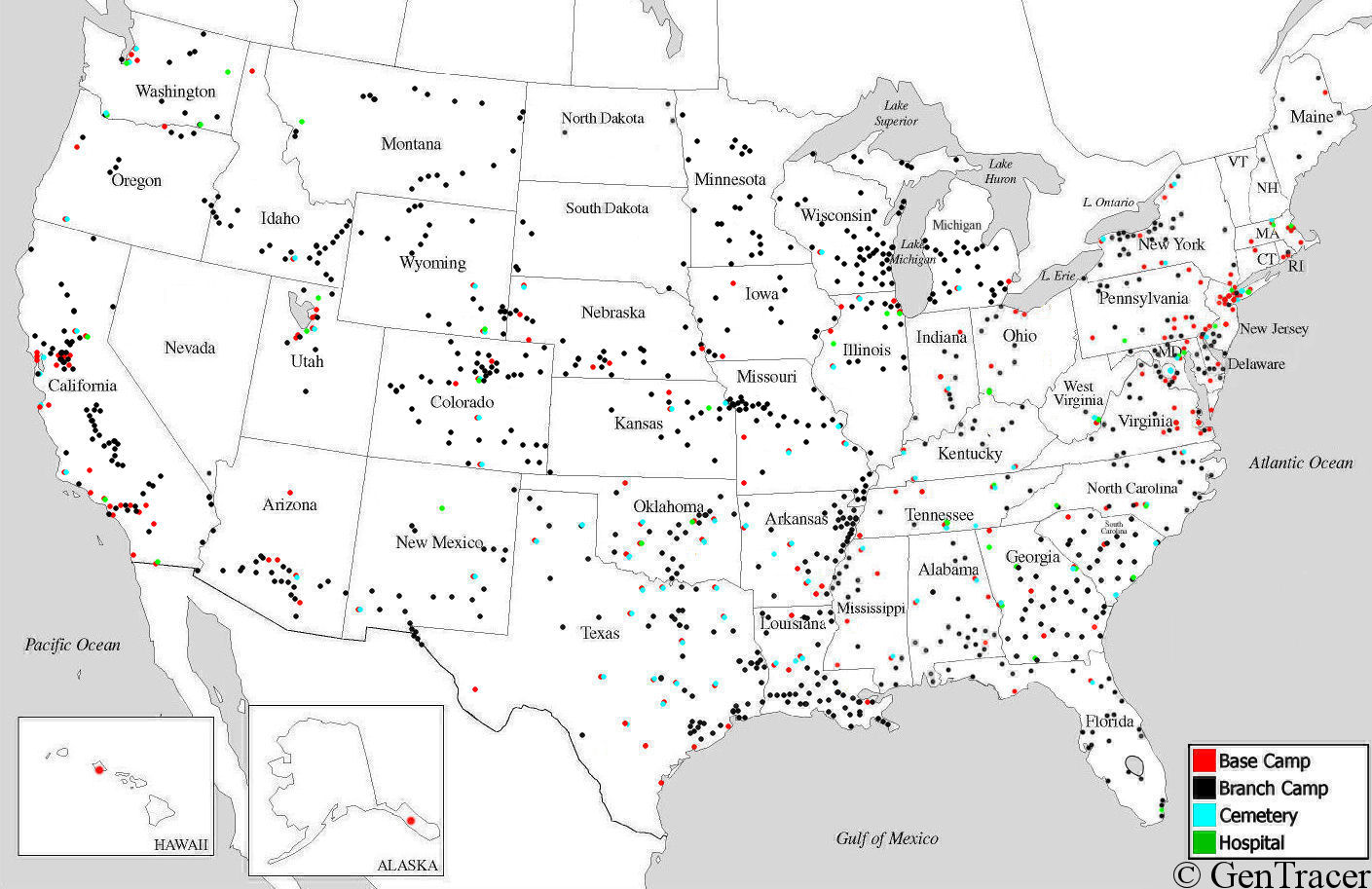
A detailed map rendering POW camp sites around the United States
During the US participation in the war, there were no less than 400,000 Axis prisoners kept in the continental US at its height. POW camps dotted the map from coast to coast, mainly in areas a fair distance from major metropolitan areas.
The US was well suited for this role in ways the UK simply could not be, despite their lack of preparation and experience in keeping POWs. America could generally afford to properly keep that many prisoners. The size of the country made escape and return to Axis lines impossible, and, unlike the UK, the US had not been blown to pieces from German bombing.
The comparative conditions of captivity for POWs kept in the UK and those kept in the US were not terribly dissimilar. Both were signatories of the Geneva Convetion, and did their best to meet that standard. The biggest difference between the two many times boiled down to the resources of the nations keeping them.
In the UK, civil food rationing had been rigorously exercised for years and could hardly be given to mouths of their captured enemy at the expense of their own people. Nor were there many excess materials to build and maintain POW camps.
During the initial phase of the war, the British used vacant estates and mansions throughout Britain to hold their German and Italian captives. It was a solution that could not however accommodate the flood of prisoners captured later in the war.
The United Stated initially experienced similar problems regarding lack of POW camps, but to a much lesser degree. They were issues the US quickly overcame.
Camps in the US scrupulously maintained the standards outlined in the Geneva Conventions for prisoner facilities. From proper living space to food rations, and conduct by their captors, the rules were closely observed. Many camps were newly constructed and specifically designed for the purpose of keeping POWs.
Most prisoners that were kept in either the US and UK generally recalled favorable experiences. POWs kept in the US thought the experience to greatly exceed their expectations. Though given the treatment by Germans toward many of their captured prisoners, the bar was very low.
It is well noted that some German troops were taken aback by luxury of the Pullman railcars in which they rode to their destinations following arrival. Some even commented that when they saw cities like New York, Detroit and Chicago for the first time, showcasing US industrial capacity at work, they knew the war was lost for Germany. All this was in addition to the amazement of being in a country totally untouched by frontline fighting or aerial bombardment.
Everyday life for Axis troops kept in the US once again was dictated by Geneva Convention standards. Once in the US and at their location of permanent detainment, enlisted prisoners would work in any number of ways, and officers could choose to work if they wished.
Prisoner labor often included a great deal of agricultural work for private citizens open and willing to take them on. Those who took on POW labor would pay the US government for the prisoners services, helping to offset the government’s cost detaining them. Prisoners themselves were paid for their labor, equivalent to their military rank for the rank of the nation’s keeping them in captivity. For example, if a prisoner were a German corporal, they would recieve the same amount paid to a corporal in the US Army.
Aside from work, prisoners were allowed to take up many different activities. Most camps had competitive sports leagues, libraries, could earn education credit for completing college correspondent courses, and much more. There were even instances of granting prisoners limited liberty in local towns once a certain amount of mutual trust was established.
The inner workings of the camps were often organized by the prisoners themselves. Officers and NCO’s assumed the role of leadership they held in their own militaries ranks. Most prisoners took pride in being able to organize and discipline themselves within the barbed wire fences.
That isn’t to say there weren’t problems that arose from prisoners. There were definitely segments of the prisoner population that continued to cherish Nazi values, secretly celebrated Hitler’s birthday, and would abuse those they felt were too cozy or open to their captors. Those prisoners believed to be particularly problematic, such as staunch Nazi’s, were transferred to facilities to keep them specifically.
More surprising yet was that over time, many prisoners developed positive relationships with those they worked for, and the communities they worked in. As one might initially expect, many Americans were frightened at the prospects of having so many enemy prisoners being kept in the US mainland. Yet this seemed to wane with time, and friendships did flourish between wartime enemies.
Axis German POWs and the Proccess of Denazification
During the captivity of German POW’s, the Allies took the opportunity to try and re educate their prisoners to break them from their Nazi totalitarian norm. The Allies effort in re education was most poignant when showing footage of the extermination camps uncovered during the Allied advance into Germany. It was a jarring experience for many German captives, and was a hallmark of their time in Allied captivity. Denazification was considered critical by the Allies to help build a successful democratic post-war Germany, and was a major step on the prisoners long journey home.
Axis POWs Post-War Repatriation
The issue of post-war repatriation was a major issue in Britain. The Geneva Conventions directed that all POWs were to be repatriated to their country of origin at wars end. However significant repatriation did not occur in earnest for prisoners under British jurisdiction until 1948.
The Clement Atlee Labour government in power after the July 1945 General Election was managing a serious manpower shortage in agriculture and reconstruction projects after six years of war. Therefore the British were in dire need of the labor that prisoners provided.
Many times official British prisoners being kept in the US by agreement were shipped from the US to Britain in late 1945, and then kept in the UK to perform these tasks. Eventually the Atlee government conformed to public pressure to repatriate Axis prisoners.
Keeping all this in mind, Axis POWs were not all a matter of the operational, and resource intensive demands of their internment. Nor the politics regarding their repatriation to Europe. POWs had considerable value to the Allies far beyond the labor they could provide.
Axis POWs Unwittingly Providing Critical Wartime Intelligence to the Allies


Trent Park, a notable site holding high ranking Axis POW officers
Holding POWs was not all just a matter of the operational concerns regarding their interment, it also had very tangible benefits beyond prisoner labor. When capturing high level officers, their ability to provide intelligence during interrogations could prove vital. However the Allies never just took prisoners at their word, they were also quite interested in what prisoners were discussing on their own time.
The most prominent wartime example is the work of MI19, the British secret service arm that bugged POWs living facilities.
Nor did MI19 place recording devices in prisoners personal quarters alone; they exhaustively outfitted entire camps with microphones. This practice is most well known for its role recording high ranking officers languishing at Trent Park. Trent Park was then an empty British estate once owned by the Sassoon family toward the north of London.
Over the course of the war, especially as the British began taking more POWs, MI19’s eavesdropping cultivated a myriad of vital intelligence. As well as gaining a clearer picture of Nazi genocide.
When MI19 transcripts were declassified by the British government long after the war, the contents were filled with prisoner talk of how the Germans were thinking about the war, and the high ranking officers impressions of Hitler himself. They also unwittingly divulged significant information about the German wonder weapons, specifically the V1 and V2 rocket development at Peenemünde.
Yet it was their unconscionable accounts of the holocaust that proved most disturbing. Prisoners spoke about everything from the Einsatzgruppen in the East, to whispers of the extermination camps. The information gathered from these recordings secretly informed a great deal of post-war tribunals, such as those at Nuremberg. Though the recordings were never officially submitted as evidence. Needless to say, should one possess anything less than an iron stomach, the transcripts are a very difficult read.
Axis POWs held in the Soviet Union: A Footnote
While this question specifically asked about POW’s in American and British hands, it is important to at least note the experience of those prisoners taken by the Red Army.
If Axis troops were taken prisoner by the Soviets while fighting on the Eastern Front, it was a very different and harsher scenario compared to the US and Britain. Axis prisoners were used as forced labor, had very poor living conditions, and most were not repatriated to Germany or other former Axis nations until the early 1950’s – no less than six or seven years after the wars end. Long story short, those Axis POWs taken by either the US or the British were considered among the very lucky few.
Recommended Reading:
“The Barbed-Wire College: Reeducating German POWs in the United States during World War II” by Rob Rabin
“Men in German Uniform: POWs in America during World War II” by Antonio Thompson
Recommended Watching:
“The Germans we Kept” Timewatch, BBC
“Bugging Hitler’s Soldiers” Secrets of the Dead, PBS
Want to hear more from Paul K. DiCostanzo? Listen to his D-Day interview on KFAB 1110AM about if the D-Day Invasion Failed with Gary Sadlemyer!

Do you have a WW2 question? Then email the Brain Bucket!
Write to Paul K. DiCostanzo at pdicostanzo@tgnreview.com
Join the Conversation - Follow TGNR on Social Media: Facebook, Twitter, Tumblr, Pintrest, Instagram, & Flipboard