
Cogito Ergo Recenseo
Sex, Drugs, and Communes
A review of Jeff Richards’s new memoir Nothing Left to Lose or How Not to Start a Commune that analyzes his of coming-of-age in the 1960’s.

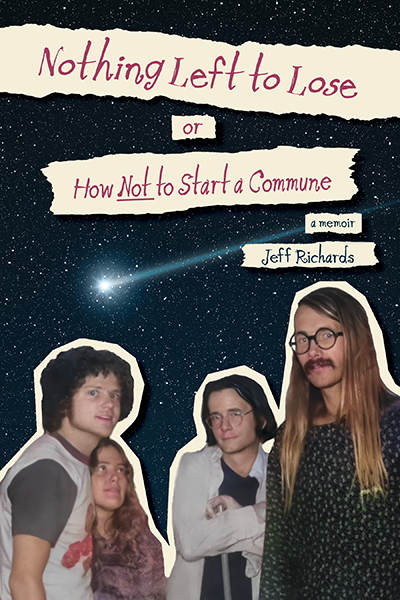
In a sentence, Nothing Left to Lose or How Not to Start a Commune by Jeff Richards recalls the narrator’s late college years and twenties spent amidst the anti-war, hippie counterculture movement that took root during the Vietnam War.
Or, in other words, pursuing sex, drugs, and psychedelic rock to varying degrees and not necessarily in that order of importance. To be fair, the music mostly came first. Mostly. Peppered in with various other misadventures involving drugs, often in the courtship of women, and at the tail end the embrasure of the outdoors.
Note the absence of the “commune” mentioned in the title.
Title Trouble
The second conjunct of Richards’s title, How Not to Start a Commune, encompasses something deeply problematic with the text: false advertising. The second portion of the title suggests multiple attempts and different approaches to starting a commune.
The principal characters – Jeff, our narrator, Rick, his best friend, Annie Pie, Rick’s younger sister, J.B. – form a merry-go-round of college friends, connections, neighbors, and dope dealers, never inaugurate a single commune throughout the entire memoir. Jeff and Rick had a marijuana fueled idea to start a commune to escape the draft, be self sufficient, and dislodge themselves from capitalism as they understood it.
However, following graduation Jeff and Rick prospect a piece of land in Colorado for possible purchase and on good advice (a mother’s of course!) they back out. This is the closest the group gets to actualizing their plan to start a commune. Afterwards, sometimes with additional people who will go on to variously pop in and out of the story which requires some page hunting to remember connections, Jeff and Rick rotate from one flop apartment to the next in the Colorado area.
Jeff on rare occasions refers to these apartments as communes with no explanation as to why they meet the criteria, but objectively as institutions they are far from the actual communes the posse visit in Taos, New Mexico which the group find contrary to their lifestyle (e.g. no running water, no meat).
Other than a smattering of lip service from Rick about getting their commune up and running, no additional efforts are made by Jeff and Rick to establish a self-sustaining community. This memoir does not recount any sort of “how not to start a commune”. It’s just not about communes. If this part of the title was meant ironically, unfortunately, the phrase didn’t leave the reader smiling but instead confused, waiting for commune foundation mishaps that never materialized.
Rather, in lieu of establishing communes, our narrator dives head first into the surging anti-war, hippie freak (narrator’s terminology) counterculture, absorbing their ideas and riding hallucinogenic waves of psychedelic drugs.
 Mindbuck Publicity
 Author Jeff Richards Courtesy of Mindbuck Publicity
“Yes” to Drugs, “No” to War, “Free Love”…We’ll Talk About It
Drugs, specifically weed Jeff’s senior year of college, was the gateway into the anti-war hippie counterculture in which our narrator and his web of friends immersed themselves during his senior year and following graduation.
Though temporarily a cog in the Capitalist Machine by day during his father’s terminal illness, Jeff would smoke, drop acid, jam to psychedelic rock, and protest the war in Vietnam in time off the clock. To the narrator’s credit he is introspective about this double life at this and other significant junctures which keeps the narrative from going too far off the rails.
Before long he and Rick relocate to Colorado and engage in various low-paying jobs to feed their true lifestyle of bucking the system and protesting the war. And doing drugs.
The narrator at one point freely admits to wanting to do drugs all day because it symbolized a rejection of the materialism and conformity he witnesses in previous generations (i.e. his parents). Except, for rejecting materialism, Jeff becomes very unsettled when itinerants they welcome into their home steal his records, and he has no cognitive dissonance about driving a muscle car, specifically a mustang. Most likely this is because the car lends to the true objective of the narrator: getting laid.
This section of the book, which is substantial, emerges as a mixed bag of tedium and historical interest. Experiencing an acid trip for the first time with Jeff is interesting; weathering the umpteenth hallucinogenic ride is akin to being the sober one at a party where everyone else is inebriated. The jokes and sensations grow stale and the reader becomes impatient for the storyline to progress. The same can be said regarding the narrator and women.
The overused contrast of Rick the Best Friend always having a woman and Jeff having to struggle – albeit what the memoirist recalls – despite this being the Era of Free Love feels unsatisfying. The reader wants their protagonist to have some variation in his outcomes.
Still, the narrator packs this portion of the book with fascinating information about the zeitgeist during the late sixties. He covers all the extremes from communist conspiracy theorists with President Nixon opening China, to his step-grandmother who cannot adapt to changing societal norms.
He walks us through the algorithm that is the draft physical and the tension of watching the draft lottery. His group watches the moon landing (high of course) and he attends in person more than one historically significant anti-war march and concert rally. Inarguably, Jeff lived during tumultuous but exciting times and he is not ignorant of that in recapturing his life during this period. For students of history such first-person witnessing of events will be enlightening. For those who lived it, the nostalgia pedal will be on overdrive.
Over the River and Through the Woods
During the final portion of the memoir, Jeff and Rick have recommitted themselves to nature and after misadventures on a float trip from Oregon to San Francisco, meeting up with Annie Pie, and time on a nude beach, Jeff and Rick take a long walk in the woods next to said beach.
They traipse by every imaginable incarnation of hippie freak available at the time, from an incomprehensible chanting circle to hobos cooking out of a bean can. Both come to the revelation that while they are unhappy with the Capitalist Machine, they don’t want to fit in with the conga line they just passed by either and start heading back home.
To Read or Not to Read?
This book has a very specific audience in mind: those who experienced the sixties and those that wished they had.
That being said it is to a degree a bildungsroman with certain generalizable themes: finding one’s place in the world after leaving the structure of college; dissatisfaction with the status quo, whether that be the government or the economy or both; the search for companionship; escapism.
These ideas are familiar to most people from when they were in their twenties so readability regarding Nothing Left to Lose or How Not to Start a Commune by Jeff Richards boils down to taste: are you ready for a magic carpet ride?
Write to: Kristen E. Strubberg
*Disclaimer: An advanced copy of Nothing Left to Lose or How Not to Start a Commune was provided by the publisher for the sake of this review. The publisher received no advanced copy of this review prior to publishing, and no monetary compensation was transacted.


