
Cogito Ergo Recenseo
26 Seconds by Rossana D’Antonio: Broken Wings | Review
A Review of 26 Seconds: Grief and Blame in the Aftermath of Losing My Brother in a Plan Crash by Rossana D’Antonio.

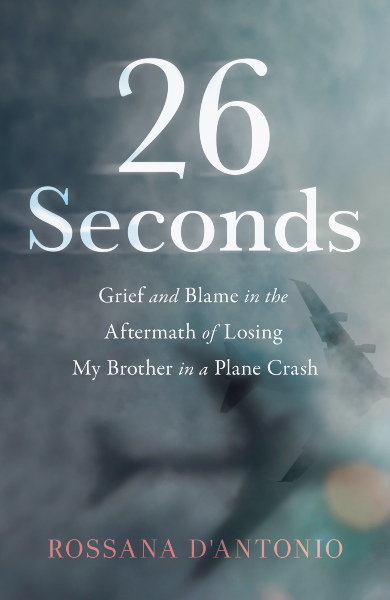
26 Seconds: Grief and Blame in the Aftermath of Losing My Brother in a Plan Crash by Rossana D’Antonio blends two complimentary styles of literature to recount the loss of her youngest brother, Cesare, a pilot, in a plane crash, a plane which he was piloting, in Honduras.
First, she utilizes memoir for the first half of the book to introduce us to Cesare and relate the tragedy of the crash and immediate after math. Secondly, she adds investigative narrative to get to the bottom of what caused the disaster.
The hard facts from his wreck and other accidents similar to Cesare’s ground the reader in the present while still allowing D’Antonio to weave in memories of her brother to contrast him with herself. However, sometimes, the author lets herself get in the way of the narrative.
26 Seconds
When strictly remembering the time of Cesare’s sudden death and directly afterwards, D’Antonio’s writing is immediate and gripping. Within pages, the reader receives the time stamps of flight gear and brake deployment; a second by second countdown to Cesare’s demise.
The writer communicates well the frustration and mental dissonance as she and her husband fly from Spain to El Salvador for a plane crash victim. Distracting from these excellent lines about shock and grief are asides about the Catholic Church in which D’Antonio was raised.
For a self-described woman who needs facts and no longer believes in God or the Church, she spends a lot of ink on both. While some topics fit into her grieving process others sidetrack from the story of Cesare and never reconnect.
For example: she discusses how one of the priests at her school eventually was arrested and convicted of molestation. Neither she nor Cesare were victims. To the reader this story comes out of left field, loosely related because in the paragraph before the author is relating her brother’s funeral mass.
The tone switch jars the reader. She vaguely poses the question survivors of all kinds ask: why not me? However D’Antonio expresses no hint of survivors guilt which might have tied this off-axis story back to the center.
Through the remainder of the acute aftermath the author takes several more shots at the Catholic concept of God, the Catholic Church, and Catholic Priests, going so far as to label the Catholic Faith she was raised in as the “original abusive relationship.”
A crystal angel lapel pin returned among Cesare’s belongings prompted this statement.
Still, her conclusions reflects more about the author than Cesare. Such prose makes the audience feel that the author cares more about an ax to grind with the Catholic Church than her brother’s death.
Meanwhile, between these drastic shifts in tone and topic, to cope with her grief D’Antonio, a civil engineer in the public safety sector, begins digging for facts and figures about the crash.
What drives her investigation, and turns out to be the nexus of her grief, is a mandate given to her when Cesare was born: “Look after your little brother.”
 Rossana D'Antonio
 Author Rossana D’Antonio (courtesy MindBuck Media)
(Article Continues Below...)
Read More
-
Napoleon (2023): Ridley Scott’s Historical Hit Piece | A.D. HISTORY WATCHES REVIEW
-
Oppenheimer: Did Nolan Nail The History? | A.D. HISTORY WATCHES REVIEW
-
How Historically Accurate is The Death of Stalin (2017)? | A.D. HISTORY WATCHES
If Not In Life, Then Death
Following the various international safety bureaus’ investigation into the accident they deem pilot error to be the preliminary root cause. The author finds this unacceptable as she, in her own parallel research identified several unsafe contributing factors, specifically runway conditions, that would have led to the crash.
The safety officials, needless to say, were unaccepting of her protests. So, grieving that she could not protect her brother in life, D’Antonio moves to protect here brother’s name in death and digs deeper into the data.
As a civil engineer she has a secret super-power: she is fluent in the jargon and protocol of infrastructure and through a friend at the airlines at which her brother worked, gets the full report which the Honduran government is NOT making public.
The reason why? The final report, while still concluding pilot error as the root cause actually has buried deep in it’s technical writing the actual cause, or, rather, causes: the flawed runway, as she suspected, and the lack of TACA airlines following FAA regulation’s 15% safety margin requirement.
D’Antonio goes into a detective’s detail how one failure led to another to lead to Cesare’s runway being unsuitable for landing that fateful evening in 2008. Like in the opening portion, the author has her audience engrossed in fall of dominoes she has uncovered.
Protecting Cesare
Now, with the evidence in hand, what does D’Antonio do?
In the final section, she reinvests herself in making safety and infrastructure better. She lobbied for more money to be put into airline safety infrastructure under President Biden’s Administration. She wrote this book.
Yet, she leaves the reader feeling she could have done more. With such a “smoking gun” as she puts it, as the official report with such damning evidence, why didn’t she go to the media who in the introduction she pointed out as particularly influential in branding a pilot a hero or a failure when regarding plane crashes?
Perhaps she was satisfied that among the people who mattered, Cesare’s family, friends, and colleagues, he will always be a hero.
Write to Kristen E. Strubberg at kstrubberg@tgnreview.com
*Disclaimer: An advanced copy of 26 Seconds: Grief and Blame in the Aftermath of Losing My Brother in a Plan Crash by Rossana D’Antonio was provided by the publisher for the sake of this review. The publisher received no advanced copy of this review prior to publishing, and no monetary compensation was transacted.


